The fractional resolution achieved in our precision tests of matter–antimatter symmetry – comparing the fundamental properties of antiprotons and protons – is improving rapidly. The most precise test of CPT invariance in the baryon sector, done in our trap system, has reached a fractional resolution of 16 parts per trillion, with clear potential for further improvement by at least one to two orders of magnitude. However, accelerator operations at CERN introduce fluctuations that ultimately limit the achievable measurement precision within the facility.
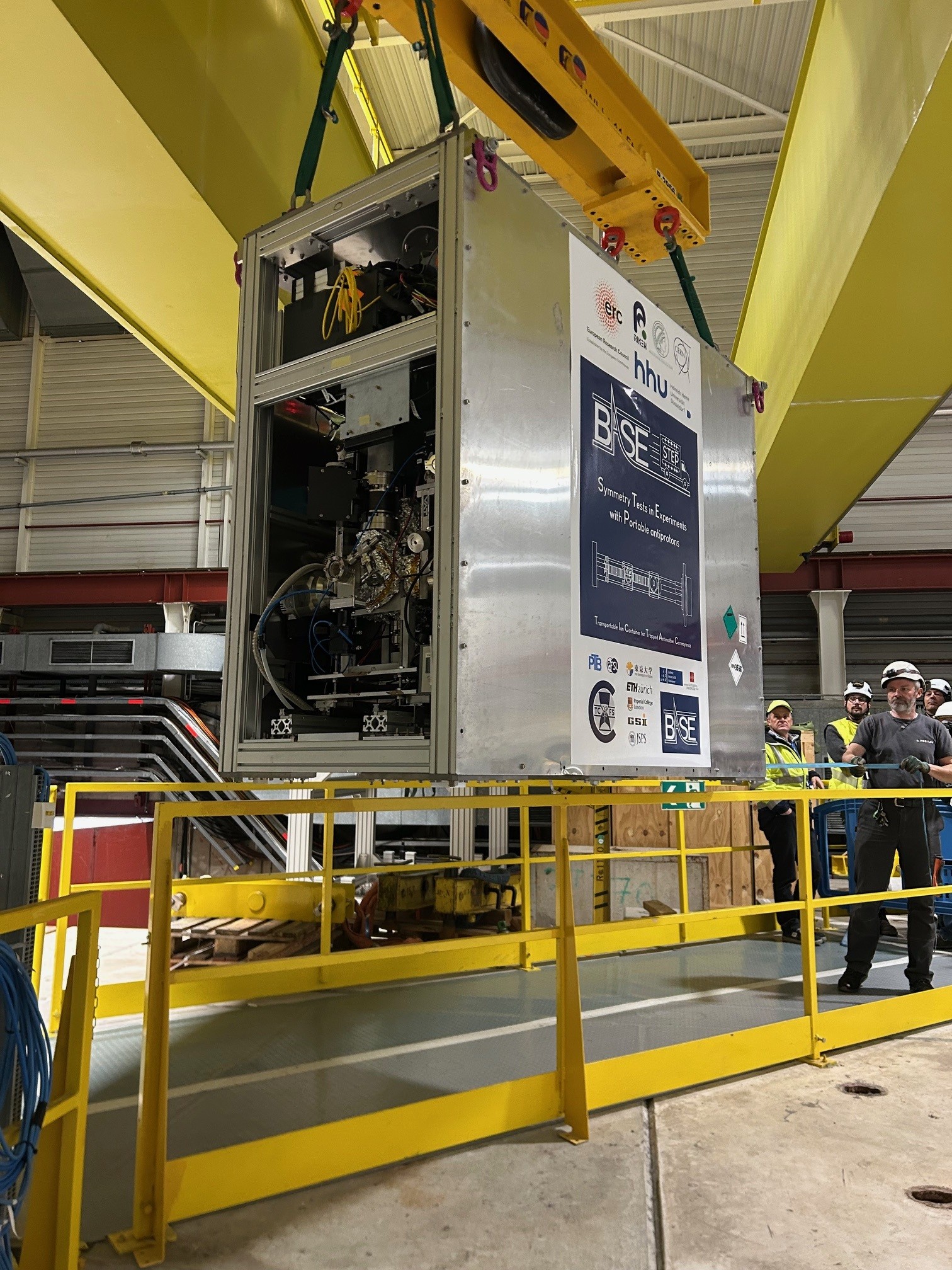
To overcome this limitation, we made in 2018 the strategic decision – enabled by reservoir, extraction, and non-destructive detection techniques developed within BASE – to construct a transportable antiproton trap. This system allows antiprotons to be moved out of the accelerator environment into dedicated offline laboratory space and to inject them into dedicated high-precision experiments. After years of conceptual design, development, testing, and commissioning, we have now demonstrated the first successful transport of antiprotons on a truck. This achievement marks a crucial milestone in the BASE experimental program and represents a potentially transformative step towards extending CERN’s antimatter research into precision laboratories beyond the accelerator complex.
The open, autonomous, cryogenic Penning-trap system developed for this purpose – BASE-STEP – was constructed under the leadership of BASE deputy spokesperson Christian Smorra, with support from the ERC Starting Grant STEP. High-precision offline laboratories are currently constructed at the BASE related Institute for Quantum Technologies and Fundamental Symmetries at Heinrich Heine University Düsseldorf, Germany.
More photos - see here: https://cds.cern.ch/record/2957407